Phase 1 – Concept and Feasibility
This Phase established the need for the Project by identifying the issues affecting the existing transport network, developing project objectives and subsequent options to support these objectives. SYSTRA Ltd. prepared the Project Phase 1 deliverables in September 2025.
Phase 1 identified initial constraints and preliminary options within the study area. These options were assessed against the Transport Appraisal Framework (TAF) [link] aligned project objectives and National Investment Framework for Transport in Ireland (NIFTI) [link] Model and Intervention Hierarchies.
Numerous options for the Julianstown Traffic Relief Scheme were considered following a robust, step-by-step process that is in line with the Department of Transport’s ‘Transport Appraisal Framework’ (TAF) guidelines. The initial longlist of options was developed as part of Phase 1 of the scheme, the Concept and Feasibility phase, which considered a variety of solutions including:
- Bus priority
- Public transport enhancements (increased bus frequency and the DART+ delivery)
- East-West Link Road south of Drogheda
- New Link Road junction with the M1 at the R150 (northbound off, southbound on slips) and connection between the R150/Laytown Road and the R150 to the M1
- New Road Link on the western side of Julianstown with a junction on the R132 north of the Laytown Road (R150)
- New Road Link on the western side of Julianstown with a junction on the R132 at the Laytown Road (R150)
- Reduction/removal of the Road Toll on the M1
All options incorporate comprehensive traffic calming measures for Julianstown, including pavement improvements, signalised junctions and HGV restrictions to improve the public realm in the village centre and create a safer environment for walking and cycling.
It should be noted that options to the east of Julianstown were not proposed due to environmental constraints, for example, Special Protection Areas for the environment.
Following an initial appraisal of these options against the objectives, Options 5 and 6 were taken forward to the Phase 2 Options Selection Stage. These are variations of new road links to the west of Julianstown to divert around the village.
Options 1, 2, 3, 4 and 7 did not progress to Stage 2 of the Option Selection. Analysis of these options indicated that traffic flows through Julianstown would not be reduced significantly by these solutions. This was due to the alternative routes (options) having longer journey times for many of the users or public transport options not considered attractive enough to encourage people to change their mode of transport.
The option considering the M1 Toll has not been taken forward because it was not likely to significantly reduce traffic flows through Julianstown. Traffic modelling and analysis looked at the origins and destinations of the traffic currently using the R132 through Julianstown and found that travelling through Julianstown is the shortest route for the majority (more than 90% of traffic in the peak). Even with the M1 toll removed or reduced, the route through Julianstown is likely to still be the preferred route for the majority of users.
Phase 2 – Options Selection
Stage 1: Preliminary Options Assessment
The project is currently in Phase 2, the Options Selection Phase.
The Option Selection examines the options against criteria, including economic benefits and the environment, through a three-stage appraisal approach.
The outcome of the Option Selection process is to identify the best solution (or ‘Preferred Option’).
The first stage of Phase 2 included a detailed Constraints Study, which was informed by a Public Consultation, to ensure all relevant constraints including Special Protection Areas, biodiversity, flood risks etc. were identified and integrated into the options assessment.
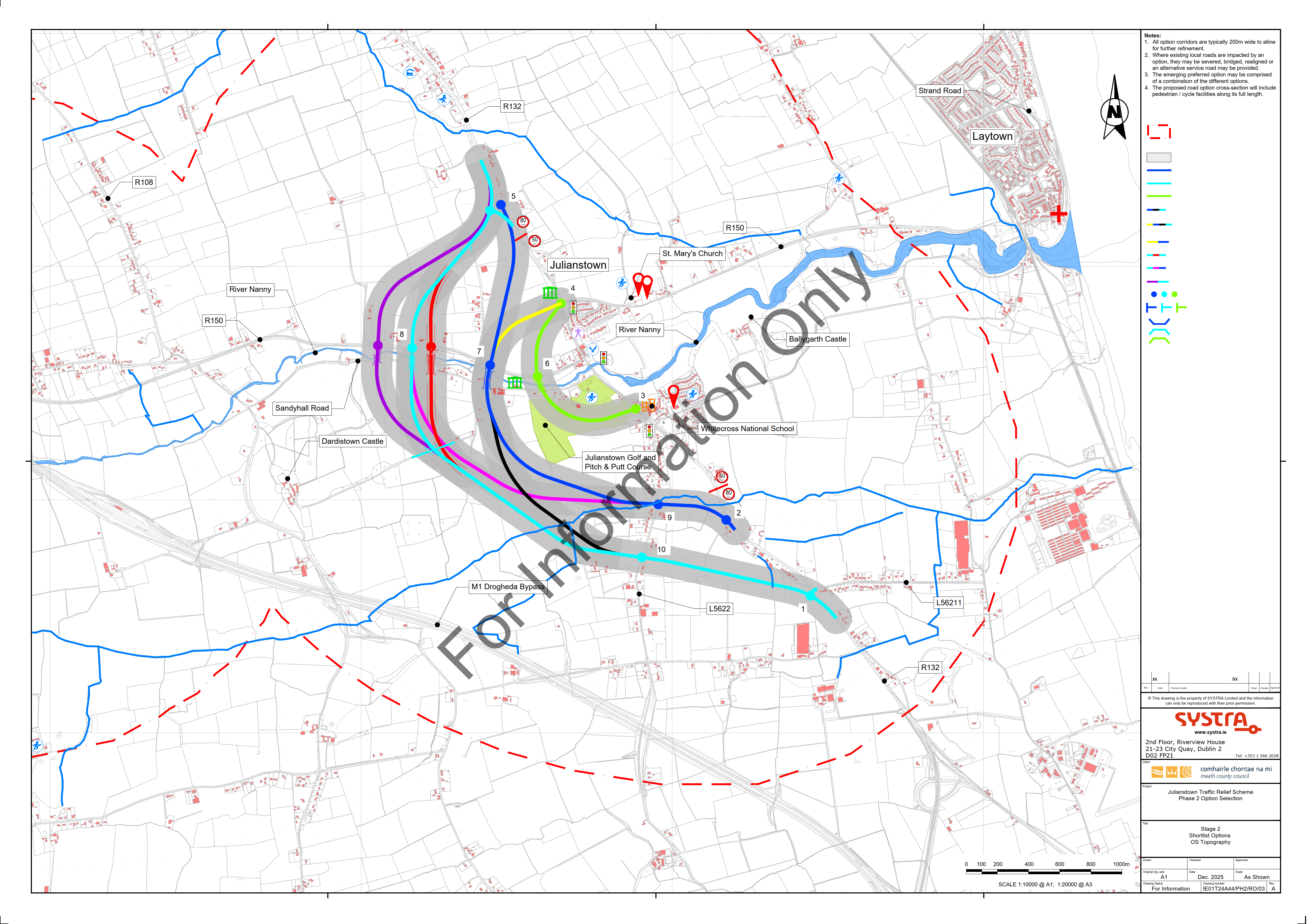
After identifying the constraints, options were developed into route corridors, nine in total. With this additional detail, the routes could be distinguished from each other on different factors including:
Route length;
Number of bridges/culverts;
Impact on the environment and local land and;
Construction costs.
Stage 2: Project Appraisal Options (CURRENT STAGE)
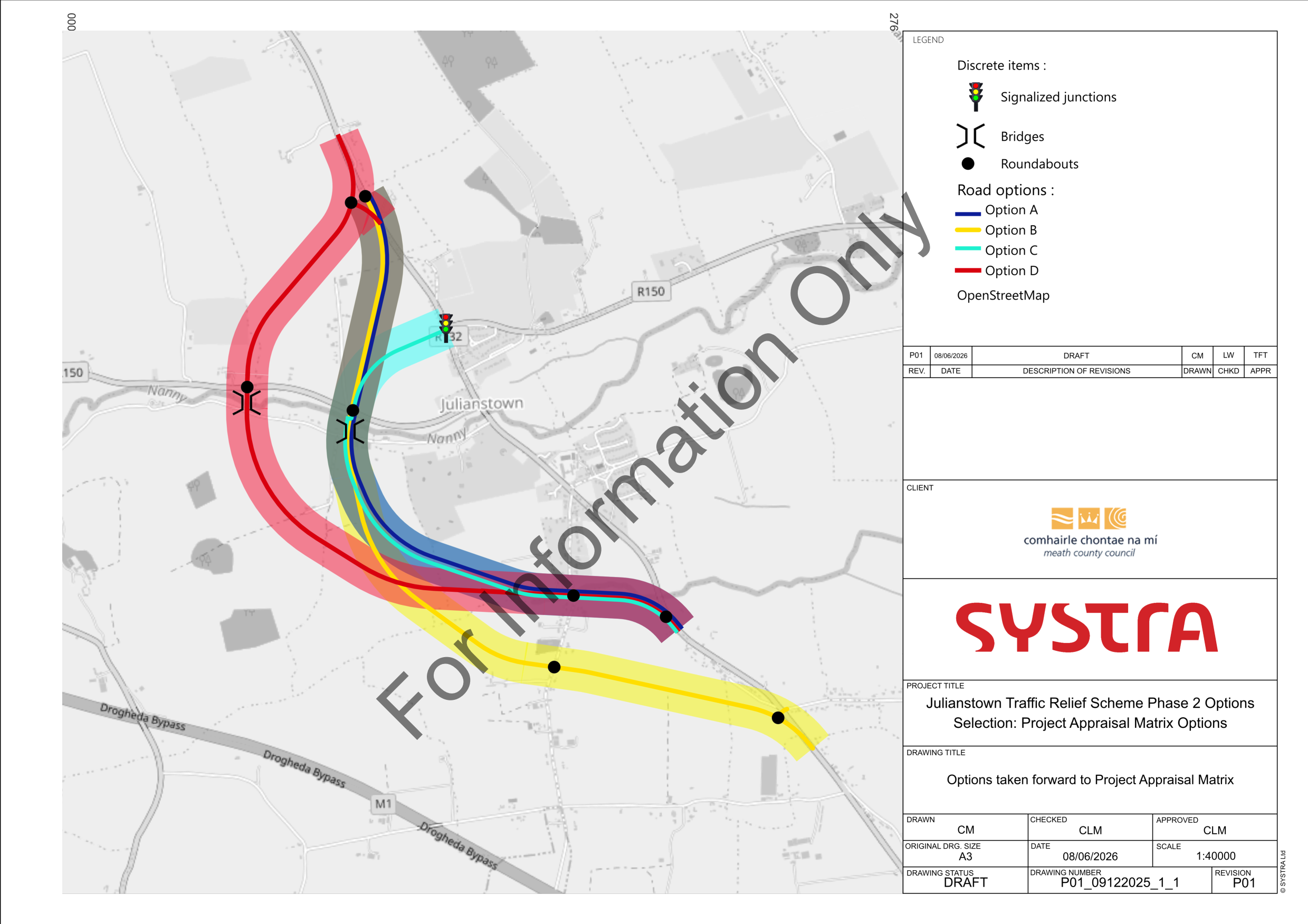
The Stage 1 Preliminary Options Appraisal assessed the nine options against the economy, environment and engineering criteria and identified four options to take forward to a more detailed assessment at the Project Appraisal Matrix stage. The four shortlisted options being taken forward to the Project Appraisal Matrix stage include variations of the following:
Northern variants: Two options for connecting to the R132 north of Julianstown.
Central alignments: Two options for the River Nanny crossing.
Southern variants: Two options for connecting to the R132 south of Julianstown.
To determine the preferred option, detailed traffic modelling is actively underway to quantify:
The operational performance;
Network benefits and;
Local environmental impacts of each proposal.
Project Appraisal Matrix Options (individual option maps can be downloaded here)
Stage 3: Selection of Preferred Options
Following Public Consultation for the Emerging Preferred Option in Summer 2026, the feedback received will be considered by the Project Team before a ‘Preferred Option’ is identified. Subject to approvals, the ‘Preferred Option’ will then be taken forward to Phase 3 (Design and Environmental Evaluation).
Phase 3 – Design and Environmental Evaluation
Subject to approvals and funding, the purpose of this phase is to develop the design of the Preferred Option selected in Phase 2, including the layout and junction arrangements, and undertake an environmental evaluation of the design to a sufficient level of detail to establish landtake requirements and to progress the project through the statutory process. During this phase, further engagement with landowners and interested parties will be undertaken as part of the ongoing design process.
Phase 4 – Statutory Process
Subject to funding and approvals to proceed, following the Design development, all documentation is compiled in Phase 4 and an application for Planning consent is expected to be lodged with An Coimisiún Pleanála.
Subsequently, an Oral Hearing may be held by An Coimisiún Pleanála regarding the proposed project in advance of them issuing a decision on the application for consent. Subject to receiving a positive decision to proceed with the project, and confirmation regarding funding, the next phase will involve procuring a contractor for construction.